Understanding Kitchen Layouts
The kitchen’s design directly impacts daily cooking routines and storage efficiency. Poor layouts lead to clutter and chaos, while thoughtful configurations streamline tasks and maximize space. Modern kitchen designs balance aesthetics with practicality, offering solutions tailored to different room sizes and household needs. Below, we break down five common layouts, highlighting their strengths and challenges.
Straight-Line (Single-Wall) Layout
Ideal for studios or small apartments, this minimalist design arranges cabinets, appliances, and countertops along a single wall.
Pros:
Space-efficient: Perfect for narrow kitchens, leaving room for adjacent dining or living areas.
Simplicity: Easy to navigate with everything within arm’s reach.
Cons:
Limited storage: Fewer cabinets may require creative organization.
Crowded workflow: Multiple cooks can feel cramped.
L-Shaped Layout
This corner-based design places counters and appliances along two adjacent walls, forming an "L" shape.
Pros:
Effective workflow: Aligns with the classic "kitchen triangle" (sink, stove, fridge), minimizing movement.
Versatile storage: Corner cabinets and extended countertops offer ample space.
Cons:
Blind spots: Upper corner cabinets may be hard to access.
Cost: More materials and labor than a straight-line layout.
U-Shaped Layout
Three walls of counters and cabinets create a U-shape, ideal for medium to large kitchens.
Pros:
Maximized storage: Abundant cabinets and counter space for appliances.
Efficient workflow: Zones for prep, cooking, and cleaning keep tasks organized.
Cons:
Space demands: Requires a larger room to avoid feeling cramped.
Corner challenges: Deep corners may need specialized storage solutions.
Island Layout
A freestanding countertop or cabinet placed centrally, often paired with open-concept kitchens.
Pros:
Multipurpose hub: Functions as a prep area, breakfast bar, or social space.
Enhanced interaction: Encourages family or guests to gather while cooking.
Cons:
Ventilation needs: Open layouts require powerful ventilation to manage cooking odors.
Space constraints: Islands demand significant floor space for safe movement.
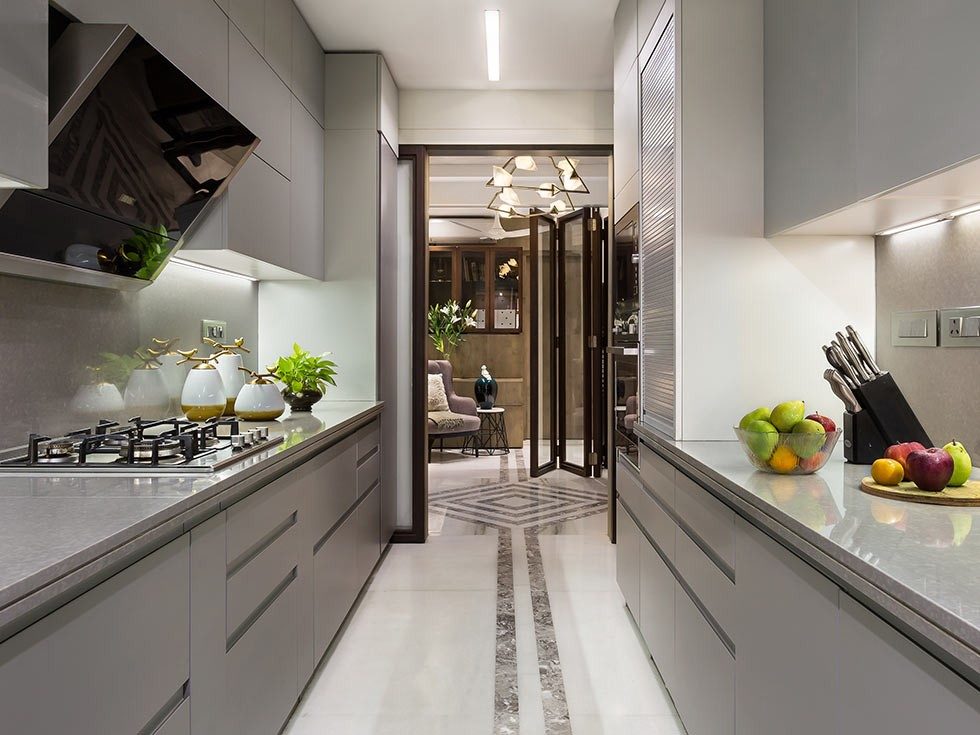
Gallery (Parallel) Layout
Two parallel countertops face each other, common in commercial kitchens but adapted for homes.
Pros:
Dedicated zones: Separate sides for prep and cooking streamline tasks.
Ample storage: Dual rows of cabinets maximize vertical space.
Cons:
Narrow walkways: Tight spacing can hinder movement in smaller kitchens.
Home inefficiency: Better suited for large or commercial spaces.
Key Considerations for Your Layout
Room size: Compact spaces favor straight-line or L-shaped designs, while larger kitchens accommodate islands or U-shapes.
Lifestyle needs: Frequent entertainers benefit from open island layouts, whereas solo cooks may prioritize efficiency.
Budget: Complex designs (e.g., islands) often require higher installation and material costs.